
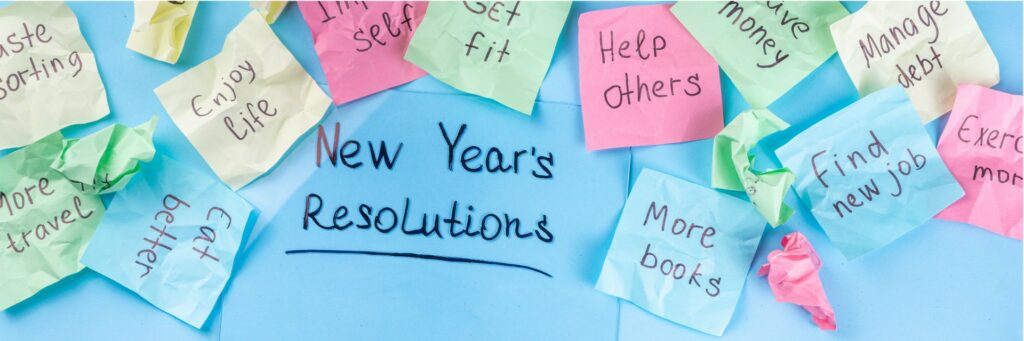
We Here Highly Resolve… New Year’s Resolutions
This is the time to set New Year’s Resolutions for starting over and striving to improve by setting challenging year-long goal(s) to be the best version of yourself.
This is the season of fresh notebooks, unopened planners, and heroic New Year’s Resolutions.
We stand at the edge of a brand-new year full of conviction. This is the year we finally get disciplined. Focused. Healthy. Organized. Enlightened. Insert your favorite self-improvement adjective here.
And by the end of next week, the goal you started with so fervently is usually out of focus.
January has a way of whispering promises it can’t keep.
It’s not that we don’t mean well. It’s that we often start at the wrong end of the story. We focus on the resolution instead of the destination. We commit to the activity without clarifying the outcome. We sprint before checking the map.
Over the years, I’ve learned that meaningful change doesn’t begin with enthusiasm. It begins with perspective.
Beginning at the End
For years now, I’ve been part of a coaching group focused on running both life and business with intention rather than inertia. One of the most helpful habits I’ve developed is regularly revisiting my goals—not just what I want this year, but what I want over a lifetime.
That sounds grand, maybe even intimidating, but it doesn’t have to be. It simply asks one question:
When this chapter closes, what do I want to be true?
From there, I work backward:
- Primary lifetime goals
- Ten-year goals
- Three-year goals
- One-year goals
Each step closer narrows the focus. Each shorter timeline forces clarity. Big ideas become smaller, sturdier, and more actionable.
For example, “I want to be healthy” is noble but vague. “I want to be strong enough to hike with my grandchildren” is specific. “I want to exercise five days a week” is actionable. “I will walk, lift, or stretch for at least 30 minutes before lunch on weekdays” is calendar-ready.
The end gives meaning to the beginning.
As Simon Sinek urges, we need to update and redefine our Why.
The Myth of the One-Year Attention Span
I’ll confess something freely: I have a short attention span.
I am not wired to stay intensely focused on a single goal for an entire year. And according to Gino Wickman, author of Traction, neither are most people.
Wickman makes a simple but powerful observation: a year is too long to maintain urgency. Instead, he suggests setting one to three measurable goals for a 90-day period—challenging but attainable—and revisiting them quarterly.
Ninety days is close enough to feel real.
Far enough to matter.
Short enough to hold your attention.
This idea changed how I approach goal-setting. Instead of making one massive promise in January and quietly abandoning it by February, I now think in seasons.
What matters most this quarter?
What would meaningful progress look like in the next 90 days?
What small habits, done consistently, move me closer to the end I have in mind?
Each week, I check in. Not with judgment, but with curiosity. What worked? What didn’t? What needs adjusting?
Over the last two years, this approach has produced steady, modest improvements. Nothing dramatic. Nothing headline-worthy. But over time, those small steps accumulate.
Progress is rarely loud, and doesn’t need to be. Persistent One Percent improvements add yom like compound interest.
Aiming Higher (and Forgiving Yourself)
When I look back over my goals from eight years ago, I sometimes wish I had aimed higher. Not because I failed, but because I survived them. I learned that I was capable of more than I gave myself credit for.
In the health and fitness arena, for instance, I haven’t always been faithful to eating for health. Vegetables and I still have a complicated relationship. But I have exercised five or six days a week for years now.
That consistency didn’t come from willpower. It came from identity. I stopped asking, “Will I work out today?” and started assuming, “Of course I move—what kind of movement fits today?”
That shift—from outcome to identity—is another way of starting with the end in mind. You don’t just want to do something; you want to be someone.
And even then, grace matters.
The Wild Berry Problem
Goal-setting is a useful discipline, but it can become tyrannical if we aren’t careful.
I once read a story about a Little League baseball game. Someone hit a ball deep into the outfield and into the woods. The center fielder chased it down…and never came back. Then the right fielder followed him. Then the left fielder. None of them returned.
Eventually, the adults went looking for them and found the boys happily picking wild berries in the woods.
They had forgotten the ball entirely.
There’s a lesson here.
Life will occasionally toss berries into your path—unexpected joys, detours, moments that don’t fit neatly into your plan. If your goals don’t leave room for wonder, rest, and delight, they’re probably too rigid.
You must stop and taste the wild berries every once in a while, even if it takes you off course.
That, too, is part of starting with the end in mind. Because the end isn’t just achievement—it’s meaning.
Retire with a North Star
As I get older, my goals are evolving. I’m downshifting from purely career-focused ambitions toward personal goals: relationships, health, contribution, and a quieter sense of purpose.
What does “success” mean now?
What deserves my limited energy?
What can I release?
These questions don’t have permanent answers. They change with seasons, responsibilities, and perspective. That’s not failure—that’s wisdom.
Steven Covey encouraged me to start with the end in mind. That doesn’t mean fixing the end forever. It means revisiting it regularly and allowing it to mature alongside you.
A Practical Invitation for 2026
As you enter 2026, I invite you to approach New Year’s Resolutions differently:
- Start with the end in mind. What kind of person do you want to be by March 31?
- Choose one to three meaningful goals for the next 90 days.
- Make them measurable and specific.
- Break them into weekly actions.
- Put revision dates on your calendar.
- Leave room for wild berries.
You won’t hit every goal. That’s normal. But you’ll build a life that moves intentionally rather than accidentally.
And that’s a resolution worth keeping.
I wish you clarity, courage, and a steady North Star for 2026.